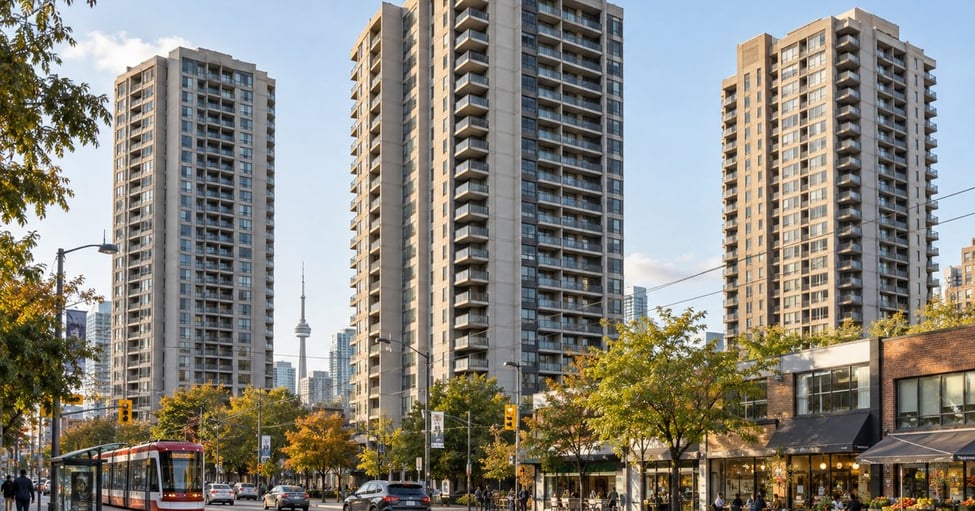
According to RENX, BST Canada has purchased three purpose-built rental buildings in Toronto for $143.8 million.
The portfolio includes 497 units across Village Gate at 775 Steeles Ave. W., Lauder Apartments at 640 Lauder Ave., and Godstone Place at 30 Godstone Rd. These are not new builds. They are older concrete apartment towers, each more than 50 years old, with high occupancy, underground parking, and mostly one- and two-bedroom units.
On paper, it is a commercial real estate transaction. But it also says a lot about where large investors still see value in the GTA housing market.
Why These Buildings Matter

BST Canada president Alaa Tannous told RENX the buildings stood out because they are concrete highrises, close to public transit, well-maintained, and located near everyday services like retail, schools, health care, universities, and employment centres.
That combination matters. Purpose-built rental is not just about the building itself. It is about whether people can live there without being isolated from the rest of their life.
If a renter can get to work, school, groceries, appointments, and transit without needing everything to be a long drive, that building has staying power. That is especially true in Toronto, where affordability has pushed many households to rent longer than they may have originally planned.
BST Canada also plans to upgrade the properties and add amenities where possible. That is a common play with older rental buildings: buy a stable asset, improve the resident experience, and make the property more competitive over time.
For renters, that can be a mixed bag. Better common areas, improved building systems, and added amenities are good things. But upgrades can also change the rent profile over time, especially when units turn over.
Institutional Money Still Likes GTA Rentals

The bigger story is not just the three buildings. It is the platform behind the purchase.
RENX reports that BST Canada recently launched a new investment platform with two institutional investors, backed by $160 million in equity to buy multifamily properties in Ontario. This acquisition is the first deal under that strategy.
That matters because institutional capital tends to move carefully. These groups are not buying because they think next month will be easy. They are usually looking at long-term demand, population growth, replacement cost, rental supply, and whether the asset can hold value through different rate cycles.
BST Canada’s stated focus is multifamily properties in Ontario, mainly in the GTA and Ottawa. It is also looking for institutional-quality buildings with more than 100 units, as well as larger portfolios.
That tells us something simple: larger investors still see purpose-built rental housing as a long-term hold, even with higher financing costs, political pressure around rents, and a market that has been uneven across other property types.
They are not focused on small condo rentals. They are focused on scale, building control, and assets where professional management and capital improvements can make a difference.
Buying Existing Rentals Instead of Building New Ones

One detail from the RENX article is worth pausing on: BST Canada is not currently looking at multi-residential development.
That is not surprising. Building new rental housing is difficult right now. Land costs are high, construction costs are still a problem, approvals can be slow, and financing a new project is not simple. Even when the demand is obvious, the math does not always work.
Buying existing rental buildings is a different path. The units are already built. The tenants are already there. The income is already operating. An investor can underwrite the property based on real performance rather than waiting years for a development to be approved, built, leased, and stabilized.
That is one reason older concrete towers continue to attract attention. They may not look exciting from the outside, but they are often hard to replace. A 15-storey rental building near transit would be expensive and time-consuming to recreate today.
For anyone watching housing supply, this is the tension. We need more rental housing, but the easiest assets to finance and trade are often the buildings that already exist.
What This Means for the Local Market
A purchase like this does not change the market overnight. It does not suddenly create hundreds of new rental units. It transfers ownership of existing ones.
But it does show confidence in long-term rental demand across Toronto and the broader GTA.
For renters, it is another sign that professionally owned rental buildings will continue to be a major part of the housing landscape. For small investors, it is a reminder that the rental market is not one single category. Owning one condo unit is very different from owning a 194-unit concrete tower with underground parking and institutional backing.
For buyers, it also reinforces a point we see often: many households are renting longer, either because they are saving for a down payment, waiting for the right property, or trying to make the numbers work with current rates. That rental demand supports buildings like these.
And for homeowners or would-be investors, the lesson is not to copy what a large institution is doing. Their access to capital, timelines, risk tolerance, and operating teams are completely different. The useful part is understanding what they are betting on: location, durable rental demand, transit access, and buildings that can be improved over time.
The Takeaway
BST Canada’s $144 million purchase is more than a headline about three apartment buildings. It is a signal that large investors still believe in older, well-located GTA rental housing.
The takeaway: when institutional money moves into purpose-built rentals, it is usually looking past short-term noise and toward long-term demand. In Toronto, that demand is still very real.