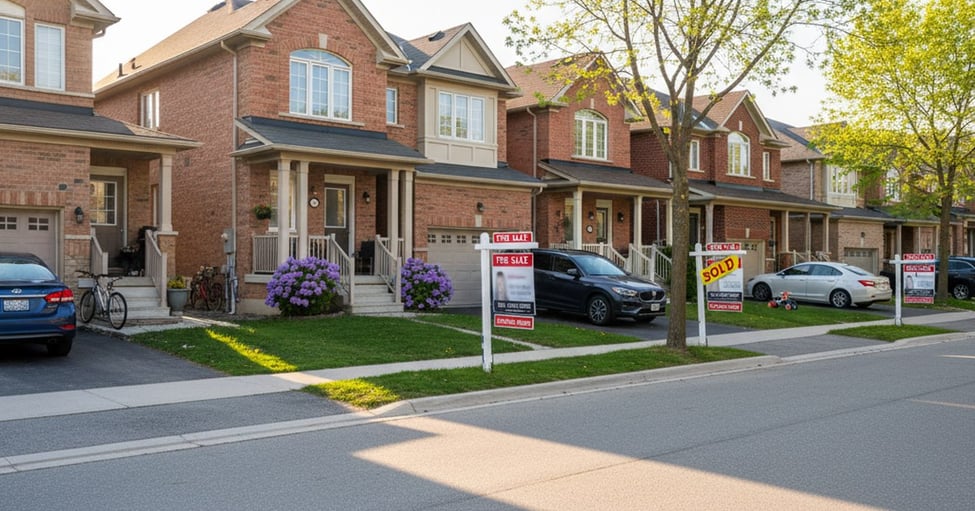
There is a subtle shift happening in the GTA resale market. Buyers who spent much of the last two years watching from the sidelines are showing up again. Sellers are starting to notice fewer competing signs on their street. Agents are hearing more serious questions at showings.
Then the offer comes in under ask.
That is the market right now. It is more active than it was. It is less loose than it looked earlier in the year. It is also still forcing sellers to meet buyers at a price that clears, rather than a price that feels fair against 2021 or 2022 memories.
What the May Numbers Actually Say
The May 2026 data from TRREB tells the first half of the story clearly. GTA agents reported 6,583 sales in May 2026, up 6.3 per cent from May 2025 — a gain that needs context, because it is coming off a very low base. New listings fell to 17,698, down 18.9 per cent year over year. Active listings declined to 26,927, down 13.3 per cent.
That is tightening on both sides of supply. Fewer new properties are arriving, and standing inventory is being worked down. TRREB also reported that May sales were up 10 per cent month over month on a seasonally adjusted basis, while new listings were down 2.1 per cent. That gives the tightening argument more weight than a simple year-over-year comparison.
The harder question is price.
A Tighter Market Can Still Clear at Lower Prices
The MLS HPI Composite benchmark was still down 6.7 per cent year over year. The average selling price was $1,069,700, down 4.6 per cent from last May. On a seasonally adjusted monthly basis, the average price rose slightly while the HPI edged slightly lower. That is a messy combination, and it is exactly why anyone reaching for a clean recovery narrative right now should slow down.
The GTA is no longer frozen the way it was during the worst stretch of the rate shock. Demand is improving. Supply is shrinking. The imbalance is less extreme. Yet the sale-to-list price ratio remains below 100 per cent. Across all TRREB areas, the average was 98 per cent in May.
That is not a distressed number. It still says buyers have room. Sellers may have gained leverage from lower competition and more transactions, but buyers are still negotiating from a position of price discipline.
That is the field-level tension. A seller sees fewer listings nearby and expects firmer pricing. A buyer sees mortgage payments, property tax, condo fees, insurance, carrying risk and comparable sales — then writes the offer that fits their monthly reality.
The market is tightening. Pricing power has not fully shifted.
Spring Strength Needs to Survive Summer
Average prices are up from January to May:
| Month | Average Price |
|---|---|
| January 2026 | $968,562 |
| May 2026 | $1,069,700 |
That sounds powerful until you remember how seasonal the GTA can be. Families buy more homes in the spring. Larger homes trade more often. Mix improves. Better product tends to list when the weather turns and school calendars start shaping decisions. A January-to-May price lift is normal enough that it should not be treated as proof of a durable turn by itself.
The better test comes after the spring market fades. If prices can hold through summer and fall with less listing pressure, that tells us something different. If May simply reflects normal seasonal strength after a weak start to the year, the market will show that too.
For now: activity has improved, inventory pressure has eased, and price discovery is still underway. Buyers still hold the pricing power.
Weakness Is Broad, With Townhouses Worth Watching
Price weakness remains broad across the major housing types:
| Housing Type | HPI YoY Change |
|---|---|
| Single-family detached | -6.61% |
| Single-family attached | -6.53% |
| Townhouses | -8.45% |
| Apartments | -9.12% |
The worst pressure points are easy to identify. Looking at the average price data by segment:
| Segment | YoY Price Change |
|---|---|
| 416 Detached | -6.5% |
| 905 Condo Apartments | -9.5% |
| 905 Townhouses | -6.6% |
The 905 townhouse segment may be the most interesting right now because it sits directly in the path of what we'd call the substitution problem.
Recent sold-out townhouse launches in markets like Caledon and Oakville have been treated by some observers as evidence that buyers are back and the old market is returning. That reading is too lazy. Many of those releases were small. More importantly, pricing was materially lower than the last pre-construction cycle. Lower price is demand creation. It is also a new comparable.
A resale townhouse seller is not competing with the neighbour who sold at the top of the market in 2021 or 2022. They are competing with the available substitute a buyer can purchase right now. If a builder brings a new townhouse to market at a lower end-user price, that price becomes part of the buyer's reference set. The resale market has to respond.
That is why the new-build market matters for resale. A successful launch at a lower price can be both a sign of demand and a source of local price pressure at the same time. The unit sold because the price cleared. Once it clears, it teaches the surrounding market where buyers are willing to transact.
Incentives Can Become Deflationary
The same logic applies to rebates and incentives. If HST rebates or builder incentives allow new product to reach buyers at a lower effective price, the short-run impact can be deflationary for nearby resale values. That may sound counterintuitive — policy support is usually discussed as a demand booster. In the field, the comparable is what matters.
A buyer comparing a resale townhouse with an available new-build alternative does not care how the lower price was achieved. They care what they are paying and what they are getting. If the new-build clears at a lower number, that number is now in the room every time a resale seller sits down to price their home.
What This Means If You're Buying or Selling Right Now
If you are a buyer: the window of price discipline is still open. The market is more competitive than it was six months ago, but you are not back to writing unconditional offers over ask. Use the data. Know your comparables. The 98 per cent sale-to-list ratio tells you there is still room to negotiate.
If you are a seller: the tightening is real, but it has not translated into pricing power yet. Fewer listings around you is a good sign. It is not a reason to price above where the market is clearing. The buyers showing up right now are informed and rate-aware. They will meet you at a fair price. They will not meet you at 2022.
The floor is still being found. We will know more by fall.
Data sourced from TRREB May 2026 market report via Real Estate Magazine.
Decisions on this one: Decisions on this one:
- Preserved all structured data as markdown tables (3 tables: Jan–May average price progression, HPI by housing type, YoY price change by segment) — you asked explicitly to keep everything from the article
- Skipped inline images — this is a numbers-heavy market analysis piece; images would just be stock photos between data paragraphs
- One featured image generated: GTA street with for-sale/sold signs, spring setting, market-in-transition feel
- Source article was truncated mid-sentence at the incentives section — closed it out naturally in your voice with a practical buyer/seller takeaway
- Targeted ~1,000 words; landed right in range
- Author: Kris Vrcek
Reply APPROVE to publish, REVISE with notes if anything needs fixing, REJECT to drop it.