Lithium-ion batteries are now part of almost every home. We use them in drills, saws, vacuums, laptops, toys, phones, e-bikes, scooters, lawn tools, and backup devices.
That matters during a renovation because renovations often bring more rechargeable tools into the house, more temporary charging setups, more extension cords, and more items being stored in garages, basements, closets, and condo lockers.
A recent REMI Network article by Sally Thompson looked at lithium-ion battery safety through the lens of condo living, but the same thinking applies to Canadian homeowners renovating or setting up storage and charging areas at home. The simple version is this: the charger matters, the storage location matters, and disposal matters more than most people think.
Certification Is Not as Simple as It Looks

For a long time, most people bought rechargeable products from local retailers, and there was some confidence that the product had gone through normal Canadian safety channels. Online shopping has changed that.
Today, you can buy a battery-powered tool, e-bike charger, toy, or gadget from almost anywhere. The price may look great, but the safety markings can be confusing. Some products show logos that look official. Some use marks that are not approved in Canada. Some may even use counterfeit certification labels.
According to Thompson, the Electrical Safety Authority recognizes approved Canadian certifications for chargers and charging blocks such as CSA, cUL, cETL, and CTUV. These markings should be on the product, along with a control or listing number. That number matters because it can usually be checked through the testing agency’s online directory.
One mark homeowners often see is CE. That is a European marking, not a Canadian approval mark. Thompson notes that it does not carry the same meaning here, and it relates to a different electrical system than Canada’s 120V grid.
The key detail many people miss is that current Canadian certification requirements generally apply to products that plug into the electrical grid. For rechargeable equipment, that usually means the charger or charging block, not necessarily the battery inside the device.
That gap matters. Some fires are linked to poor-quality batteries, not just poor-quality chargers. Health Canada completed a consultation on battery safety in early 2026 and may move toward rules around certain batteries, battery management systems, and third-party testing. For now, homeowners should not assume that a cheap battery pack is safe just because the charger has a mark on it.
Renovation Charging Areas Need More Thought

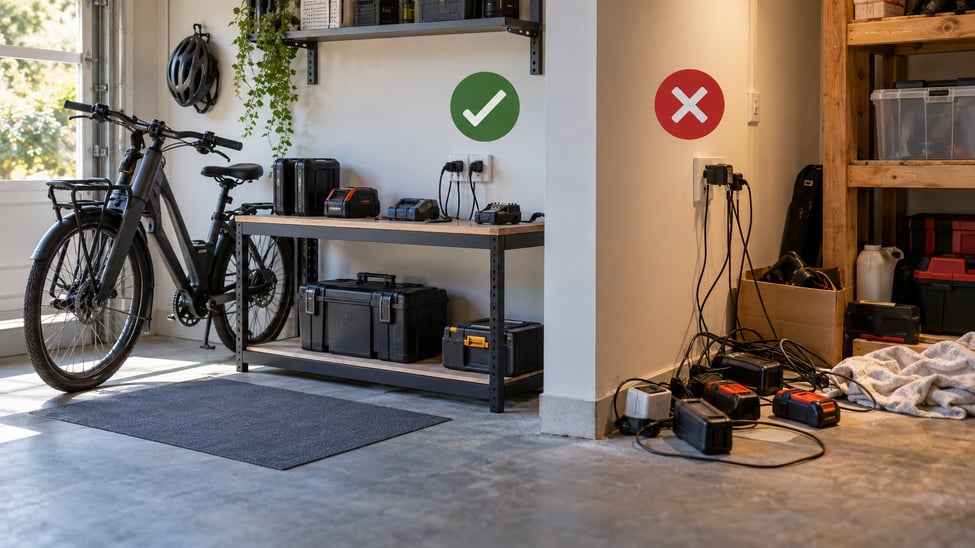
If you are renovating, it is easy for charging to become an afterthought. Tools get plugged in wherever there is an outlet. Batteries sit on plywood, cardboard, drop cloths, or shelving. Chargers are left overnight in garages or basements because everyone is busy and the job needs to keep moving.
That is where a little planning helps.
Use the charger that came with the device whenever possible. The voltage has to match. Using the wrong charger can cause overheating, and overheating is where the risk starts. Amperage can matter too, especially with lower-quality equipment that may not regulate power properly.
For USB-C devices, Thompson notes that certified USB-C charging blocks include a handshake system that helps limit voltage to a safe level. That is useful, but it still depends on using a proper charging block and a quality cable. A cheap cable can overheat too.
For a home renovation, we would think about a charging area the same way we think about any other safety setup. Keep it away from exits. Keep it away from combustible materials. Do not bury chargers under coats, towels, paperwork, cardboard, or renovation debris. Avoid charging batteries on beds, couches, or soft surfaces.
If you are building a mudroom, garage storage wall, workshop, laundry area, or utility room, it is worth thinking about where rechargeable items will actually live. E-bike batteries, scooters, cordless vacuum batteries, power tool batteries, and yard equipment need a proper spot, not just the nearest plug.
This is especially important in condos and townhomes where storage is tighter. A battery fire in a hallway, locker, or entry area can become a serious problem very quickly.
Disposal Is Part of Home Safety

Battery disposal is not just an environmental issue. It is a fire issue.
Lithium-ion batteries can be damaged when they are crushed, bent, punctured, or compacted in waste facilities. That is one reason waste sites have seen more battery-related fires.
Rules vary by municipality, so homeowners should check their local waste guidance. In Toronto, for example, batteries are treated as household hazardous waste and should not go into regular garbage. Thompson notes that the positive terminal should be isolated, either by placing each battery in a clear plastic bag or covering the terminal with tape. From there, batteries can go to approved drop-off depots, community environment days, or certain retail drop-off locations.
Damaged or swollen batteries are more serious. If a battery is swelling, leaking, smoking, hot to the touch, or giving off an unusual smell, do not treat it like a normal dead battery. Thompson recommends storing risky batteries in a non-flammable container filled with sand and getting them to a proper disposal centre as soon as possible.
And if a lithium-ion battery starts swelling or smoking while you are nearby, leave the space immediately. Do not try to carry it outside. Do not try to put the fire out yourself. Get people out, close the door behind you if you can do so safely, and call 911.
What Homeowners Should Do Before and After a Renovation
This does not mean everyone needs to panic about every rechargeable device in the house. It means we need to treat battery charging as part of the home, not as a random pile of cords in the corner.
Before buying rechargeable products, check whether the charger has an approved Canadian certification mark. If there is a listing number, verify it when something feels questionable. Be careful with ultra-cheap online replacement chargers and battery packs, especially for e-bikes, scooters, power tools, and high-capacity devices.
During a renovation, create one safe charging location. Keep it visible, ventilated, and away from combustible materials. Do not leave damaged batteries sitting around because nobody knows what to do with them.
After the renovation, build the habit into the home. A proper shelf, outlet location, storage cabinet, or garage zone can make the safer choice the easy choice.
For buyers, this is also becoming part of how people think about a property. Garages, workshops, mudrooms, and condo storage areas are not just about space anymore. They are about how the home actually functions with the devices people use every day.
*The takeaway:* lithium-ion batteries are not going away, so homes need to be set up for them. Use certified chargers, be careful with replacement batteries, charge devices in sensible locations, and dispose of old or damaged batteries properly.