New data from Teranet — the company that manages all property title registrations in Ontario — puts a number on something a lot of people in the GTA have been feeling for a while.
Thirty-six point six per cent of properties purchased in 2022 and resold in 2025 sold at a loss. More than one in three. And in Toronto and most surrounding regions, over 20 per cent of homes bought in either 2022 or 2023 that have since sold also registered a loss.
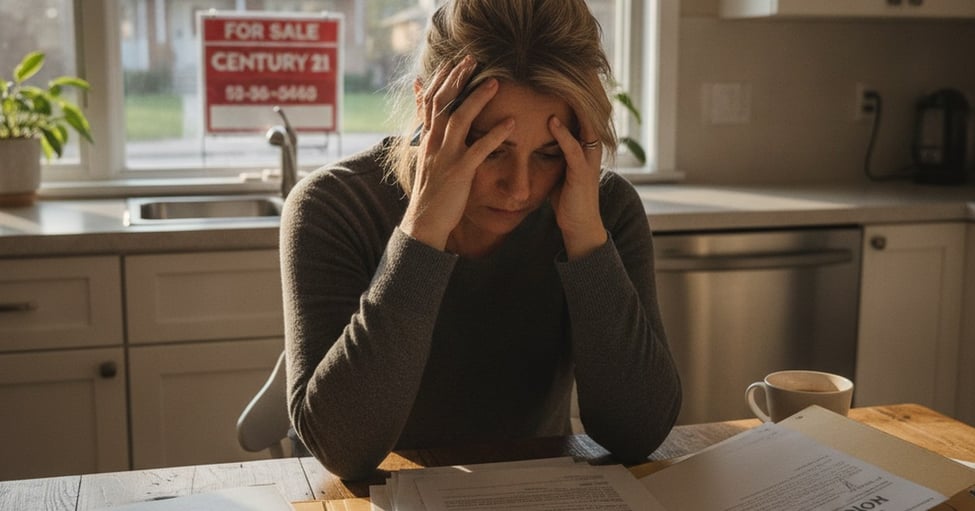
Those aren't abstract statistics. Those are real people who bought at the peak, held on, and eventually had to sell into a market that no longer supported what they paid.
What the Numbers Are Actually Showing
Teranet tracks every property title registration in Ontario, so this isn't a survey or a sample — it's the full picture.
The hardest-hit areas are outside the downtown Toronto core. Dufferin County and Peel had the highest loss rates. Cottage country north of the GTA saw loss rates exceeding 25 per cent in many regions. These were also the areas that ran hardest during the pandemic years, so it tracks that the correction would hit them the most.
Jasaman Singh, a Brampton-based agent, recently watched a seller client lose $950,000 on a four-bedroom home in Northwest Brampton. The client bought in February 2022 for $2.2 million and sold last week for $1.25 million — a 43 per cent loss.
"The bigger the house, the bigger the problem," Singh said.
He's not describing an outlier. He's describing something he's seeing regularly.
"It's everywhere."
And he doesn't think it's over. His read: "It has to get worse before it gets stable, and then better."
Power of Sale Activity Is Up 400 Per Cent
This is the number that should get your attention if you own a home you bought between 2020 and 2022.
According to Teranet, power of sale transfers in Ontario climbed to 2,979 in 2025. That's up from 2,123 the year before — and fewer than 600 in 2022. That's roughly a 400 per cent increase in three years.
Teranet's own read is that the trend reflects homeowners renewing mortgages at significantly higher interest rates, or carrying variable-rate debt that's been eating them alive.
Jonathan Alphonso, a Toronto-based mortgage broker and private lender who works specifically with distressed borrowers, is seeing it up close.
"People who are calling me now and want to sell, they're not in a good place. Divorce or they have other debts they need to get rid of. Some of them have no money whatsoever, not even living expenses, and they are already leveraged to the maximum."
He said people are only selling in this market if they absolutely have to — and he expects the trend to continue.
If you're a GTA homeowner who bought near the peak and your renewal is coming up, this is the environment you're operating in. The market isn't going to bail you out on timing. The best thing you can do is get ahead of it — talk to your mortgage professional now, before you're in a corner.
Is This Actually an Opening for Buyers?
There's another side to this story, and it's worth being honest about it.
Tracy Valko, founder and brokerage owner of Valko Financial, works through a high volume of mortgage applications. Her read on where the market is heading is worth paying attention to.
"I feel like the Ontario housing market is increasingly becoming a first-time homebuyer market. It's obviously not an investor market anymore."
"It's allowing people to take advantage of those windows, where there's not as much competition, and they're able to have more negotiating power."
She also flagged something in the Teranet data that surprised her: the average first-time homebuyer age in Ontario has climbed to 40. From her experience, people are still getting into the market in their mid-30s, often with help from parents on the down payment or co-signing. But the fact that the average has moved to 40 tells you something about how long people have been waiting and how hard it's been to get in.
For buyers who've been sitting on the sidelines — especially in areas like Peel and Dufferin where the correction has been sharpest — the math is genuinely different now than it was two or three years ago. There's more inventory, less competition, and more room to negotiate. That doesn't mean there's no risk, but it does mean the conversation is different.
What This Means If You're Buying or Selling Right Now
If you're selling a home you bought in 2022 or 2023, the first thing you need is an honest price conversation — not a number that reflects what you paid or what your neighbour listed for, but what the market will actually support today. The gap between those two numbers is real, and pretending otherwise just extends your carrying costs.
If you're a buyer, particularly a first-time buyer, the current environment has more to offer you than any point in the last four years. Price reductions are happening. Sellers are negotiating. And in a market where a lot of listings are coming from people who need to sell rather than people who want to sell, your position at the table is stronger.
The Teranet data is a snapshot of what happens when prices run far ahead of fundamentals and then rates move. We're living through the correction. The question now is what you do with that information.
---
*The takeaway: over a third of Ontario homes bought at the 2022 peak have sold at a loss, and power of sale activity is up 400 per cent since then. If you're holding one of those properties, the window to act on your own terms is still open — but it doesn't stay open forever. If you're a buyer, this market has your attention for good reason.*