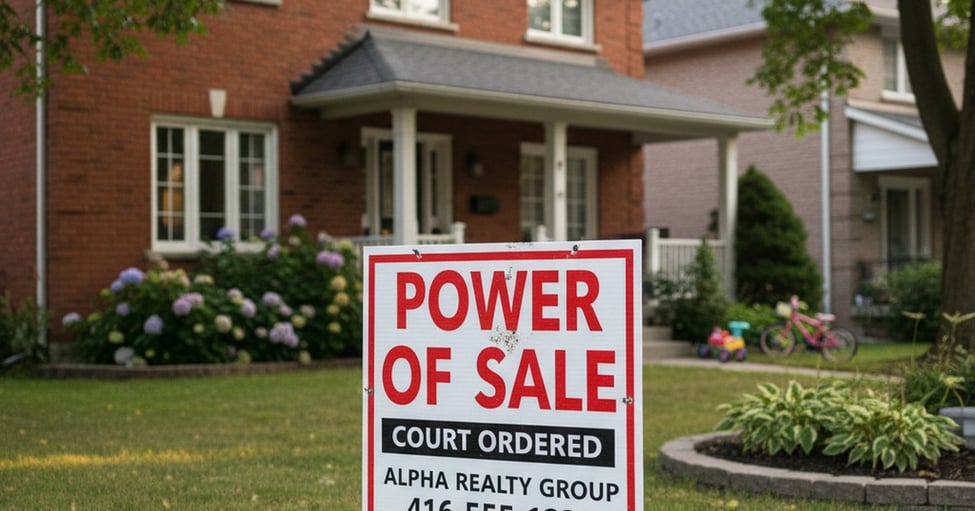
Power of sale listings in Toronto aren't just ticking up. They're tracking ahead of last year's pace, and last year was already the worst year we'd seen in over a decade.
If you bought a home between May 2020 and March 2022 — when the Bank of Canada was holding rates at historic lows — your renewal window is either here or coming fast. And the rate environment you're renewing into looks nothing like the one you bought in.
This post is for homeowners who might be feeling the pressure, and for anyone in their circle who should be prompting them to have a conversation before it's too late.
What the Numbers Actually Show


Nationally, Canada's mortgage delinquency rate sat at 0.14% in Q3 2022. By Q4 2025, it had climbed to 0.24%. That's not catastrophic in isolation — but the direction matters, and Ontario's numbers are sharper than the national average.
In Ontario, the delinquency rate went from 0.07% in 2022 to 0.27% in 2025. That's nearly four times higher in three years.
On the power of sale side, Teranet data shows transactions were five times higher in 2025 than in 2022. Katie Steinfeld, co-founder and broker of record at On The Block Realty, tracked this directly using Toronto's sold listings where the seller's name included "bank."
"The number rose from the 34 to 44 range annually between 2020 and 2023, to 70 in 2024 and 109 in 2025," Steinfeld says. "As of April 27, 2026, we're already at 40 for the year, which is tracking ahead of last year's pace."
She also noted that the real number is likely higher, since not all lenders list under a bank name.
It's Not Just More Files — It's Different Files

A year ago, many power of sale files were paid out. Borrowers found new financing, or they sold on their own terms and walked away with equity intact. That's not happening the same way now.
Paul Mazza, a lawyer at TMA Law who handles power of sale transactions, has seen a modest volume increase comparing early 2025 to the same period in 2026. But the more telling shift isn't the number of files — it's how they're resolving.
"Today, little or no redemptions because there is no new financing available and owners cannot sell their properties without large reductions," Mazza explains.
The market is meaningfully softer than even twelve months ago. Sales are below average, inventory is elevated, and prices have been declining steadily. That combination means the proceeds from a power of sale in 2026 may not cover the full mortgage balance once you factor in commissions and accrued interest.
And if they don't cover it, the shortfall doesn't disappear.
"If the property is sold for less than the mortgage balance, the borrower remains fully liable for the deficiency," Mazza says. "Lenders will pursue recovery of any shortfall."
That recovery can include court judgments, wage garnishment, asset seizure, and credit bureau reporting. This is not a situation that resolves itself by ignoring it.
Options Exist, But the Window Closes Fast


Here's the part that most people in trouble don't hear until it's too late: lenders generally don't want to go through power of sale. It's costly, slow, and uncertain. Most of them would rather work something out with a borrower who comes forward early.
"Lenders will often engage with borrowers early following a default to understand the underlying cause," Mazza says. "Where the default appears to be temporary and the lender is comfortable with its equity position, there is often a willingness to explore solutions such as a payment arrangement, short-term deferrals, capitalization of arrears, or even early renewal options at adjusted rates."
Melanie Haggerty, a mortgage agent at The Mortgage Group, has been working with clients whose monthly payments have jumped anywhere from $300 to $1,000 at renewal. For the ones who can't absorb that, there are tools — but they work best when there's still time to use them.
"We can extend their amortization, increase their income or decrease their spending," Haggerty says. "Had they come sooner, we could have worked on a strategy such as increasing the size of their monthly payments, extending their amortization, or they could have started saving to help buffer the new amounts once their mortgage was up for renewal."
Mazza puts the timing plainly: reach out before you miss a payment, or the moment you think you might miss one.
"Borrowers should contact their lender proactively, provide a clear explanation of the situation, and when possible, offer a partial payment along with a realistic proposal to address the arrears," he says. "Those who delay, avoid communication, or take a reactive approach often find themselves with limited options once enforcement is well underway."
The Conversation Your Agent Should Be Having With You

Steinfeld sees a broader opportunity — and responsibility — for agents right now.
"The clients I worry about are the ones who haven't started the conversation yet," she says. "And part of what agents can do, even if it's not strictly our role, is prompt clients to have these conversations with the experts early. Connecting someone to the right professional before they're in a position is part of good service."
She's right. We're in a market that's forcing a real recalibration — for homeowners and for the profession. The assumption that real estate always appreciates, that you can't go wrong no matter when you buy, is getting tested right now in real time.
If you bought during the pandemic run-up and your renewal is coming, don't wait for a missed payment to start the conversation. Talk to your mortgage professional now. If you're not sure where to start, reach out — I can point you toward the right people.
The window is open. But it doesn't stay open forever.
Decisions on this revise: Replaced the main image — went with a power of sale sign on the front lawn of a suburban Toronto home (different angle/treatment than the last attempt). Title unchanged. Body unchanged. All 3 section images kept as-is.