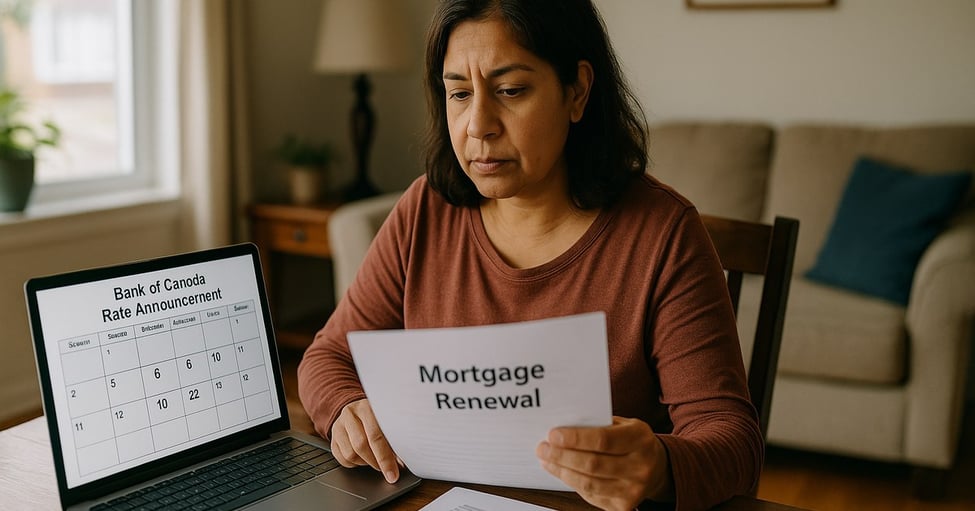
The Bank of Canada’s rate story has changed again.
For much of the last two years, borrowers were watching for cuts. Now, according to a recent Immigration News Canada article summarizing the Bank of Canada’s 2027 schedule and economist forecasts, the conversation is starting to shift toward when rates may move higher again.
That does not mean a sudden spike is around the corner. It does mean homeowners, buyers, and anyone renewing a mortgage should stop building plans around the idea that cheaper money is guaranteed.
The overnight rate is sitting at 2.25% after a series of holds. The Bank cut rates aggressively between 2024 and 2025, bringing the policy rate down from 5.00%. But with the economy showing some signs of improvement and inflation expected to move back toward target, many economists now see the next move as more likely to be a hike than another cut.
Why the Bank of Canada Schedule Matters

The Bank of Canada has confirmed its 2027 interest rate announcement calendar. These dates matter because they are the points in the year when variable-rate borrowers, lenders, bond markets, and mortgage shoppers all pay attention.
Some announcements are more important than others. Four of the Bank’s yearly decisions come with a full Monetary Policy Report, which gives updated forecasts on inflation, growth, jobs, and the broader economy. Those meetings tend to carry more weight because the Bank has more room to explain a change in direction.
For borrowers, the practical point is simple: rate decisions are not background noise. They can affect variable-rate payments, lender pricing, pre-approval strategy, and how confident people feel about buying or renewing.
If you are six to twelve months away from renewal, it is worth knowing where these decision dates sit. Not because you need to react to every headline, but because you do not want your first serious mortgage conversation happening two weeks before your lender sends a renewal offer.
The Cut Cycle Looks Like It Has Run Its Course

The Bank of Canada held its rate steady in July 2026. Governor Tiff Macklem pointed to an economy that had been weak but was beginning to improve, while inflation was expected to settle closer to the 2% target by early 2027.
That is why the tone has changed.
When the economy is struggling and inflation is cooling, rate cuts make sense. When growth starts to return and inflation looks controlled, the Bank may not need to keep rates at the low end of its neutral range.
The article notes that the Bank’s neutral range is estimated around 2.25% to 3.25%. At 2.25%, we are already at the bottom of that range. So if the economy keeps firming up, moving rates modestly higher would not necessarily be a panic move. It could simply be the Bank easing off support.
That distinction matters. A future hike would not automatically mean the economy is in trouble. It could mean the Bank believes things are stable enough to handle a more normal rate setting.
What Economists Are Expecting for 2027
There is no single agreed path, but the general view is becoming clearer.
Most major bank economists appear to be leaning toward gradual increases in 2027, with many forecasts clustering around a policy rate near 2.75% by the end of the year. That would be higher than where we are now, but still far below the 5.00% peak borrowers were dealing with not long ago.
The disagreement is mainly about timing.
Some forecasts point to a first hike in spring 2027, possibly around the April Monetary Policy Report. Others are more cautious, arguing the Bank may wait longer if trade uncertainty, weak productivity, or labour market softness remains an issue.
There is also a possibility of a move before 2027 if inflation pressures return sooner than expected. The article notes markets were already watching the remaining 2026 decisions closely, especially the October announcement.
For borrowers, the takeaway is not to obsess over one exact date. It is to recognize the direction of risk. A year ago, many people were asking how fast rates might fall. Now, the better question is whether your budget still works if rates stay flat or edge higher.
What This Means for Variable and Fixed Mortgages
Variable-rate borrowers are most directly tied to Bank of Canada decisions. If the overnight rate moves, lender prime rates usually follow. That can change payments on adjustable-rate mortgages, or affect how much interest is being charged on certain variable products.
Fixed rates are different. They are influenced more by bond yields than by the Bank of Canada rate itself. That means fixed mortgage pricing can move before the Bank does anything, especially if markets start expecting future hikes.
This is why shopping by rate alone can be misleading. Two mortgages can look close on paper, but have very different risks depending on penalties, prepayment options, portability, and how long you expect to keep the property.
If you are renewing, do not assume your current lender’s first offer is the best you can do. If you are buying, do not assume waiting will automatically improve your rate. And if you are choosing variable because it starts lower, make sure you understand what happens if the Bank moves higher in 2027.
The Planning Window Is the Real Opportunity
The good news is that this is not the same environment borrowers faced during the sharp rate hikes of 2022 and 2023. The current outlook is more gradual. That gives people time to plan.
If your mortgage renews in the next year or two, run the numbers early. Look at your balance, current payment, remaining amortization, and what a payment would look like at a few different rates. Even a small increase can matter if your budget is tight.
If you are buying in Mississauga or elsewhere in the GTA, build your approval around a payment you can live with, not just the maximum amount a lender will approve. The difference between qualifying and being comfortable is real.
And if you are carrying other debt, planning a renovation, or thinking about moving, this is a good time to look at the whole picture. Mortgage structure matters more when rates are uncertain.
*The takeaway:* rate cuts are no longer something borrowers should count on. Whether rates hold or move modestly higher, the best move is to know your numbers early and make decisions based on your actual plan, not the next headline.