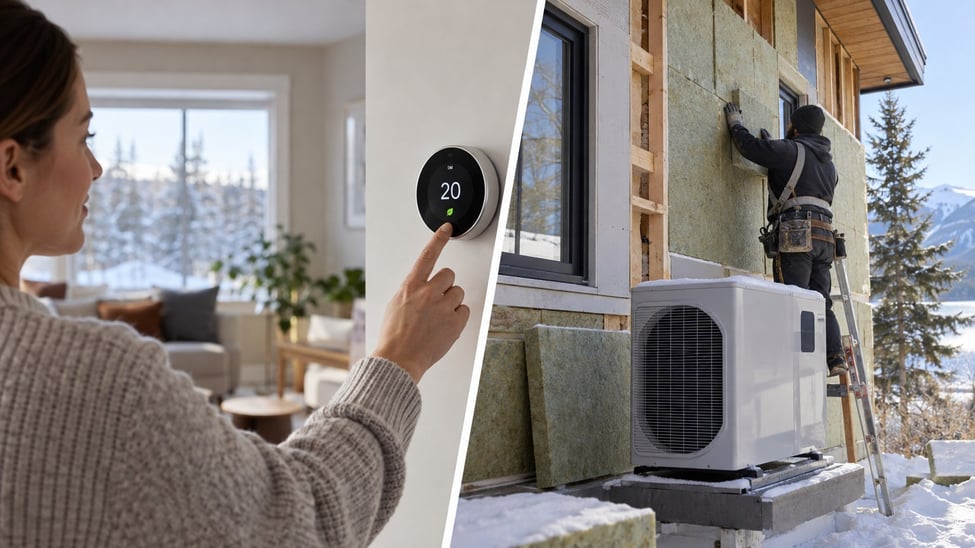
If you are thinking about putting money into your home this year, energy efficiency is one of the few renovation categories that can do two things at once: lower monthly costs and make the property more appealing when it is time to sell.
That does not mean every upgrade has the same payoff. Some are quick wins. Some only make sense if your house, heating system, local electricity rates, and rebate options line up properly.
Adam Chahl’s recent piece on energy-efficient upgrades Canadians are prioritizing in 2026 makes a useful point: the best improvements are not always the flashiest ones. Smart controls, insulation, heat pumps, windows, and solar all have a place, but the order matters.
Put another way, if your home is leaking heat, it usually makes more sense to fix that before spending big money on equipment.
Start With the Low-Cost Wins

Smart thermostats and heating controls are usually the easiest first step.
They are not exciting, but they can make a noticeable difference, especially in homes with electric baseboard heat or older controls. Chahl points to BC Hydro examples showing some smart thermostat upgrades paying back in under two years, depending on the home and heating setup.
In Québec, Hydro-Québec has also promoted savings from replacing old dial thermostats with electronic or smart options. The exact savings will vary, but the bigger point is simple: better controls help you avoid heating rooms when you do not need to.
For homeowners who are not ready for a major renovation, this is a practical place to begin. It is also an upgrade buyers understand quickly. Lower bills are easy to explain.
Insulation Is Still the Workhorse

If there is one upgrade that gets overlooked because it is hidden behind drywall or tucked into an attic, it is insulation.
That is a shame, because in a Canadian home, heat loss is usually where the money goes. Space heating remains one of the biggest energy uses in the house, so improving the building envelope can have a real impact.
For many older homes, the attic is the starting point. After that, basement walls, crawl spaces, rim joists, and air sealing are worth looking at. The right R-value depends on the province and climate zone, so this is not a one-size-fits-all job.
From a resale perspective, insulation may not photograph like a new kitchen, but it can still matter. A home that feels less drafty during a showing, has more consistent room temperatures, and comes with lower utility bills is easier for buyers to trust.
Heat Pumps Are Promising, But the Math Depends on Your Home

Cold-climate heat pumps are getting a lot of attention, and for good reason. They can provide heating and cooling, and in the right situation they can reduce operating costs meaningfully.
The key phrase is “in the right situation.”
If you are replacing oil heat or electric resistance heating, a heat pump may be one of the strongest upgrades available. Ontario program guidance has pointed to major savings in those scenarios. The Canadian Climate Institute has also found that heat pumps can be a lower-cost heating and cooling option over the life of the system for many households.
But if you already have an efficient gas furnace and relatively low gas costs, the payback may be less dramatic. That does not make a heat pump a bad idea. It just means the decision should be based on your actual numbers, not a headline.
This is where homeowners should be careful. Before spending thousands, look at your current fuel type, annual bills, electrical panel capacity, rebate eligibility, and whether you also need air conditioning.
Windows and Solar Are More Selective
Windows are one of the upgrades homeowners often want to do first. They are visible, they change the look of the home, and old windows can create drafts, condensation, and noise problems.
But if we are talking strictly about energy bill payback, windows are often slower than insulation or controls. Chahl notes current Canadian pricing can put a full window replacement project into the many-thousands-of-dollars range. That means the comfort and curb appeal benefits may be the main reason to do them, with energy savings as a bonus.
If your windows are failing, rotting, fogging, or causing real comfort issues, replacement can absolutely make sense. If they are just dated, you may want to price insulation and air sealing first.
Solar is similar in that the math is very regional. In places with higher electricity costs, strong rebates, good sun exposure, and a suitable roof, solar can be compelling. In lower-cost hydro provinces, or on homes with shaded roofs, it may be a second-phase upgrade.
The rebate picture matters a lot here. The broad federal Canada Greener Homes Grant and Loan programs are closed to new applications, according to Natural Resources Canada, so homeowners now need to look more closely at provincial and utility programs. Examples include Ontario’s Home Renovation Savings program, Québec’s LogisVert, and solar or battery incentives where available.
The Resale Angle
Energy-efficient upgrades are not only about saving money month to month. Buyers are paying attention too.
CMHC research cited in Chahl’s article found that energy efficiency matters to many buyers, and a large share of homeowners who completed energy upgrades reported lower bills. That does not mean every buyer will pay a premium for every upgrade, but it does mean efficiency is part of the conversation.
For sellers, documentation helps. Keep invoices, rebate approvals, energy audits, equipment specs, and utility comparisons where possible. A buyer is more likely to value an upgrade when they can see what was done and why it matters.
For buyers, energy costs should be part of the affordability conversation. Mortgage payment, property tax, insurance, utilities, maintenance, and future replacement costs all belong in the same budget discussion.
The best energy upgrade is not always the most expensive one. It is the one that solves the right problem in the right order.
**The takeaway:** in 2026, Canadian homeowners are prioritizing upgrades that can lower carrying costs and support resale value. Start with controls and insulation, then look at heat pumps, windows, and solar once the numbers make sense for your specific home.