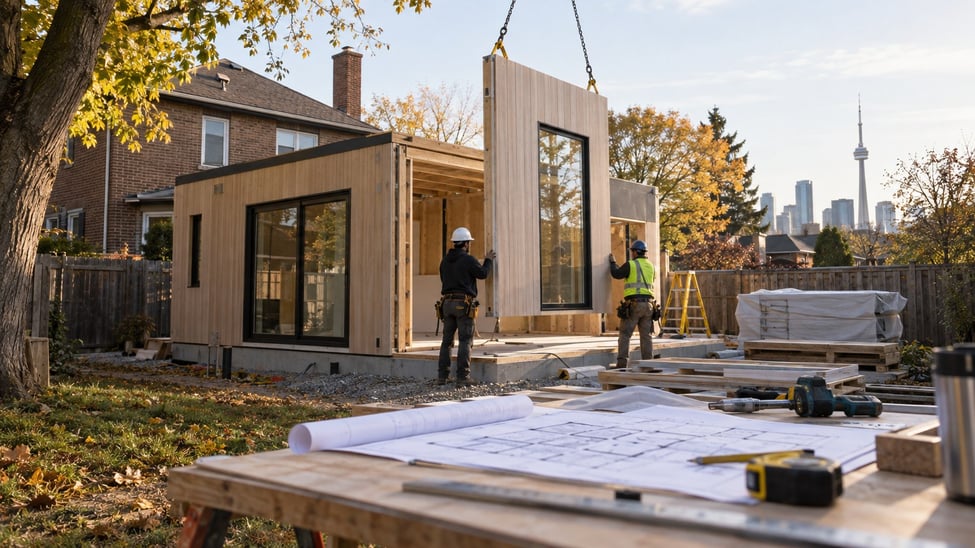
A CBC News report on Toronto’s laneway and garden suite program points to two things being true at the same time.
First, people are building them. CBC reported that Toronto had 755 garden and laneway suites under construction, with 627 permits closed. That is not nothing. For a housing type that was once treated as unusual, those numbers show real uptake.
Second, those numbers do not prove that backyard suites are a simple rental-investment win.
A suite under construction is not the same as a finished unit. A finished unit is not automatically a rental. And a rental is not automatically profitable once you factor in construction costs, financing, taxes, insurance, maintenance, vacancy, and the time it takes to get through approvals.
That distinction matters, especially for homeowners looking at a laneway or garden suite as a way to create income.
The Demand Is Real, But So Is the Friction
Laneway and garden suites make sense on paper. They add housing without requiring a full redevelopment of the lot. They can create space for aging parents, adult children, caregivers, or tenants. They can also help homeowners make better use of property they already own.
That is why the construction count matters. It shows that Torontonians are not just talking about gentle density. Some are actually moving forward.
But CBC’s reporting also highlights the friction homeowners and builders are running into. The article points to concerns around permitting delays, repeated back-and-forth with city staff, and approval systems that may not always fit newer construction methods, especially panelized or prefab builds.
That part is important. If a project is supposed to be faster because components are built off-site, but the approval process still treats it like a conventional custom build, the time savings can disappear quickly.
And time is money. Every extra month can mean more carrying costs, more uncertainty, and more risk for the homeowner.
Permits Are Not the Same as Profit
The headline number, 755 suites under construction, is useful. But it should not be stretched beyond what it actually tells us.
It does not tell us how many of those suites will be used as long-term rentals. Some may be built for family. Some may become home offices or guest spaces. Some may not reach completion on the timeline the owner originally expected.
It also does not tell us what the final project cost will be. That is where the investment conversation gets more serious.
A homeowner might start with a budget that looks manageable, then run into design revisions, servicing costs, utility upgrades, tree protection requirements, drainage issues, or financing changes. Even a well-planned project can shift once the real site conditions are known.
Then comes the rental math.
If someone is borrowing to build, the mortgage or loan payment has to be compared against realistic rent, not best-case rent. Property taxes may change. Insurance needs to be reviewed. Repairs and vacancy need to be assumed. And if the owner is planning to refinance later, the lender may not value the new income exactly the way the homeowner expects.
That does not mean the numbers cannot work. It means they need to be tested before anyone commits.
The City Has a Role to Play
The homeowners and builder in the CBC story are not asking for the city to ignore standards. They are asking for a smoother path, with clearer workflows and rules that better reflect how these projects are actually being built.
That is a fair conversation.
If Toronto wants more small-scale housing, the process has to be understandable for regular homeowners, not just people who can afford to hire a full team and wait through multiple rounds of revisions.
Financial incentives could also make a difference, depending on how they are structured. A grant, rebate, low-interest loan, or fee relief program could help close the gap for owners who want to build a rental unit but are stuck on upfront cost.
The key is making sure any incentive actually leads to usable housing, not just more paperwork.
A clear approval process matters just as much as the policy goal. Homeowners can handle rules. What creates frustration is when the path feels uncertain, slow, or inconsistent.
What Homeowners Should Think About Before Building
If you are looking at a laneway or garden suite, start with the purpose.
Is this for family? Rental income? Long-term resale value? Aging in place? A future downsizing plan where you live in the suite and rent the main house?
The answer changes the financial plan.
If the goal is rental income, be conservative. Use realistic rent estimates. Build in vacancy. Ask what happens if construction takes six months longer than expected. Ask what happens if rates are different by the time the project is finished.
Also look at financing early. Some homeowners assume they can simply pull equity from the house and build. That may be true, but the amount, rate, payment, and approval conditions all matter. If the household budget is already tight, adding more debt for a project that will not generate income until completion needs careful planning.
For buyers, this is also worth watching. A property with laneway or garden suite potential may be valuable, but potential is not the same as approval. Before paying a premium, confirm zoning, access, servicing, setbacks, trees, parking, and any site-specific issues.
The difference between “could build” and “can build affordably” can be significant.
The Takeaway
Toronto’s 755 suites under construction show that homeowners are interested and that the policy is being used.
But that number should be read as evidence of uptake, not proof of easy rental returns.
Laneway and garden suites can be a smart housing solution and, in some cases, a strong financial move. The win comes from clear approvals, realistic budgets, proper financing, and conservative rental assumptions, not from assuming every backyard unit automatically pays for itself.