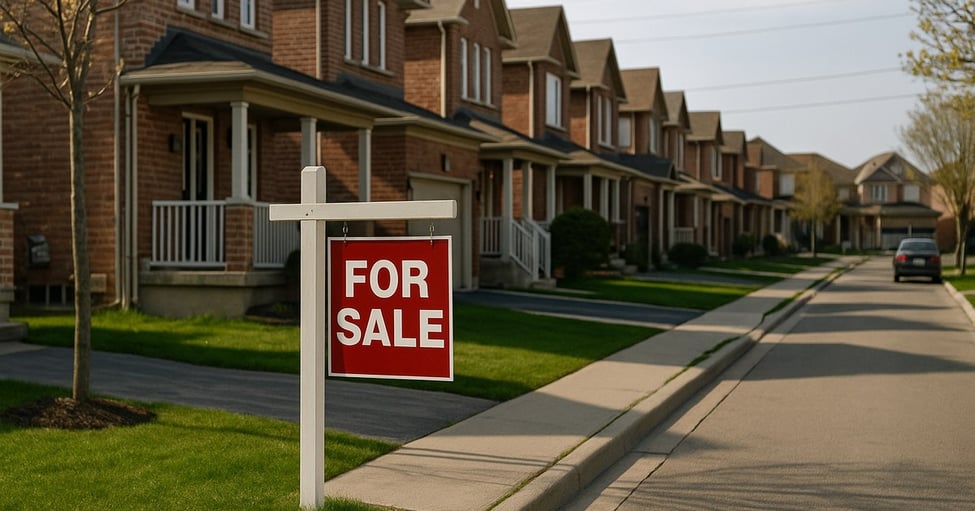
A new CP24 story by Jermaine Wilson, based on Wahi’s July MLS analysis, shows something we see on the ground all the time: the GTA is not moving as one single market.
Some neighbourhoods are still selling quickly. Others are taking two months or more. The difference comes down to location, property type, price point, and how much work the buyer thinks they will have to do after closing.
That last part matters more than some sellers realize.
Wahi found that Alderwood in Etobicoke was the fastest-selling GTA neighbourhood in July, with homes averaging just 10 days on the market. Palmer in Burlington followed at 15 days, while Uptown Ajax and Dovercourt Park averaged 16 days. A few other pockets in Etobicoke, Milton, Markham, Whitby, North York, and Toronto also moved in 17 days or less.
On the other side, Chaplin Estates in midtown Toronto averaged 77 days. Tansley Woods in Burlington averaged 71 days. Bronte Lakeshore in Oakville came in at 65 days, Burlington waterfront at 64 days, and Brampton’s Queen Street Corridor at 62 days.
That is a big spread inside the same region.
Days on Market Is Telling Us What Buyers Want

The homes moving fastest are not random. According to Wahi economist Ryan McLaughlin, the quicker-selling areas tend to have the kind of product buyers can picture themselves living in right away: family-friendly homes, single-family properties, row homes, and places that do not require a major renovation.
That lines up with what we hear from buyers. Many people are already stretching to qualify. They are factoring in mortgage payments, property tax, insurance, utilities, and childcare. When they walk into a house and immediately see a $150,000 renovation, they pause.
A dated kitchen is not just a dated kitchen anymore. It is a financing question.
Can they afford the purchase price and the renovation? Do they have cash left after closing? Will the lender support a higher purchase price if the home clearly needs work? These are practical questions, not just design preferences.
That is why move-in ready homes can still attract strong attention, even in a slower market. Buyers may not be chasing anything at any price, but they will move quickly for a home that solves more problems than it creates.
Condos and Luxury Homes Are Facing a Different Reality

The slower-selling neighbourhoods have a different mix. Some include larger luxury homes with a smaller buyer pool. Others have more condos, and the condo side of the GTA market has been under pressure for a while.
McLaughlin pointed to new condo supply as one reason the broader market has been weighed down. Smaller units are having a particularly hard time. That is not surprising when you think about how buyer needs have changed.
A compact one-bedroom condo may have made sense when rates were lower and investors were more active. But if a first-time buyer is trying to work from home, plan for a partner, or think about a future child, a very small unit can feel limiting quickly.
Investors are also doing different math now. Higher borrowing costs, softer rents in some pockets, and larger carrying costs make it harder to justify buying a small condo purely on future appreciation.
This does not mean every condo is a bad buy. It means the building, layout, fees, location, and price matter more than ever. A well-priced condo with usable space near transit is not the same product as a tiny investor-style unit in a building with heavy competition.
Sellers Need to Price the Actual Market, Not the Old One

The hardest part for many sellers is accepting that their neighbourhood headline may not match their property.
You might hear that homes in the GTA are stabilizing, but that does not automatically mean your property will sell in two weeks. You might also hear that condos are struggling, but that does not mean every condo needs a fire-sale price.
The right question is more specific: what are buyers comparing your property to this week?
If there are five similar units in the same building, your pricing has to respect that. If your home needs updates and the renovated one down the street just sold, buyers are going to do the subtraction in their heads. If your property is unique or higher-end, the buyer pool may simply take longer to show up.
Days on market does not always mean a home is bad. Sometimes it means the property is specialized. Sometimes it means the price started too high. Sometimes it means the photos, staging, or access were not doing the home any favours.
But once a listing sits, the conversation changes. Buyers start asking what is wrong with it, even when the answer is just price.
Buyers Should Watch the Slower Pockets Carefully
For buyers, the longer-selling neighbourhoods may create opportunity, but only if the numbers work.
A home sitting for 60 or 70 days may have a seller who is more open to negotiation. That could mean a better price, a financing condition, a longer closing, or room to address inspection issues.
But a slower listing is not automatically a deal. If the property needs major work, the condo fees are high, or the layout is difficult to resell, the discount needs to be real enough to compensate for that.
This is where pre-approval and payment planning matter. Before making an offer, buyers should know what the monthly payment looks like, what cash is needed on closing, and what repairs or upgrades are likely in the first year.
The cheapest listing is not always the most affordable home to own.
The Market Is Tighter, But Not Simple
TRREB has reported fewer new listings, which could help bring the GTA closer to balance. At the same time, 2025 had the lowest annual GTA sales total since 2000, so we are not exactly coming out of a normal period.
Interest rates, inflation, policy changes, and new condo completions will all keep shaping the next few months.
The main point is this: broad market headlines are useful, but they are not enough. A detached home in Alderwood, a waterfront property in Burlington, and a small condo in downtown Toronto are not moving under the same rules.
*The takeaway:* if you are selling, price for your exact property and competition. If you are buying, look beyond the headline and ask why a home is moving quickly, or why it is sitting.