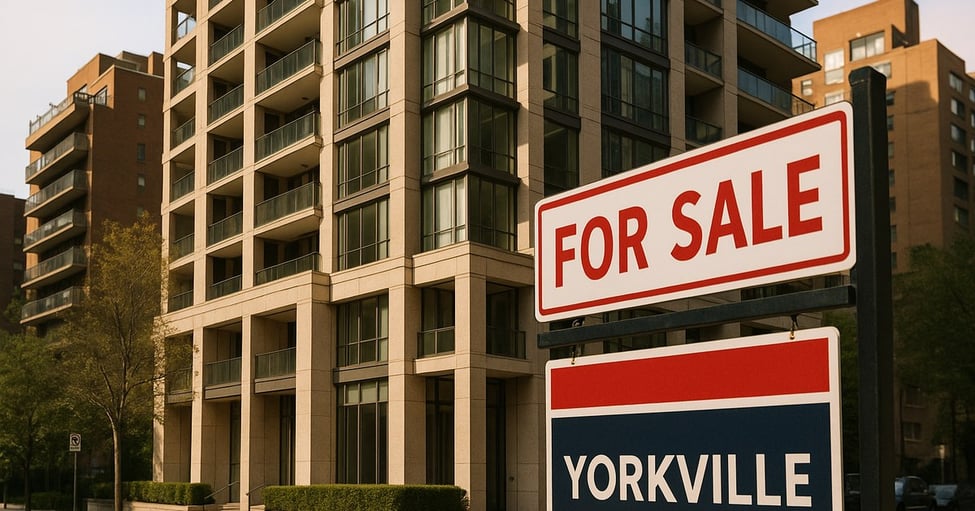
A luxury Yorkville condo reportedly selling at a $450,000 loss is the kind of headline that gets attention, and for good reason.
According to the Toronto Star, the condo market weakness that has already been showing up in smaller investor units is now being felt at the high end too. That matters because Yorkville is not a fringe market. It is one of Toronto’s most recognizable luxury neighbourhoods, and when losses show up there, people notice.
But one sale does not tell the whole story. The useful question is not, “Is every condo in trouble?” It is, “What does this say about buyer confidence, pricing, carrying costs, and timing?”
That is where the lesson is.
Luxury Does Not Make a Property Immune

There is a common assumption that premium locations are protected from market weakness. Yorkville, waterfront buildings, newer boutique projects, penthouses, anything with a luxury label. People assume those properties sit in a different category.
They do, to a point. But they are still tied to the same fundamentals: borrowing costs, buyer demand, monthly carrying costs, investor appetite, and how much competing inventory is available.
A buyer looking at a high-end condo is still asking practical questions. What are the maintenance fees? How much are property taxes? What will financing cost? Is there a better unit available in the same building or a nearby one? Can I negotiate?
When buyers have more choice and less urgency, even luxury sellers have to adjust.
The Condo Market Has a Confidence Problem

The biggest issue in the condo market right now is not just price. It is confidence.
A lot of buyers are sitting back because they are unsure where values settle. Investors are more cautious because rents may not cover the full monthly cost once mortgage payments, condo fees, taxes, insurance, and maintenance are included. First-time buyers are watching listings sit longer and wondering if waiting gets them a better deal.
That hesitation changes the whole feel of the market.
In a hot market, buyers stretch because they are afraid of missing out. In a softer market, buyers slow down because they are afraid of overpaying. Same property, different psychology.
That is why a big loss in Yorkville matters. It becomes a data point buyers remember when they walk into the next unit.
Sellers Need to Price the Market They Are In

This is the hardest part for sellers, especially anyone who bought near the peak.
The market does not care what you paid. It does not care what the previous unit sold for in 2021. It does not care what number you need to walk away clean.
Buyers are comparing your property to what is available right now.
If five similar condos are listed and two sellers are more motivated, the market will use those listings to set expectations. If a seller ignores that, the unit can sit. Once it sits, buyers start asking what is wrong with it, even if nothing is wrong.
That does not mean every seller should panic or cut aggressively. It means pricing has to be honest from the start. A strong listing strategy matters more when the market is thin because there are fewer serious buyers to begin with.
Buyers Should Look Carefully, Not Emotionally
For buyers, a headline like this can feel like permission to throw out low offers everywhere. That is not always smart.
A good deal is not just a big discount from the last sale. A good deal is a property that fits your budget, your timeline, your financing, and the long-term demand for that building and location.
Some condos are soft for a reason. Poor layouts, high fees, too much investor ownership, weak reserve funds, awkward exposure, or too many similar units hitting the market at once. Others may be genuinely good properties caught in a slower cycle.
That difference matters.
If you are buying a condo right now, look closely at the building, not just the unit. Review the status certificate. Understand the monthly fees. Compare recent sales, not just active listings. And make sure the mortgage approval still works if the appraisal comes in tighter than expected.
The Mortgage Side Matters More Than People Think
When prices are rising, financing can feel like a formality. When prices are falling or uneven, financing becomes a bigger part of the risk management.
Appraisals matter. Down payment structure matters. Cash flow matters. Renewal timing matters.
If someone bought a condo with the idea of refinancing later, selling quickly, or renting it out at a profit, the math may look very different now. Higher borrowing costs and softer resale values can narrow the options quickly.
This is where we always come back to the same point: the rate is only one piece of the decision. The structure of the mortgage, the penalty, the term, the payment comfort, and the exit plan all matter too.
A low rate is helpful. A plan is better.
What This Means for the GTA Condo Market
The Yorkville loss does not mean every condo owner is underwater. It also does not mean buyers should assume the market is collapsing across the board.
It does show that the weakness is not limited to entry-level investor units. High-end condos can feel it too when buyers become selective and sellers have to meet the market.
For sellers, the message is to be realistic early. For buyers, the message is to be disciplined, not reckless. For owners coming up for renewal, the message is to understand your numbers before you are forced into a decision.
*The takeaway:* luxury location helps, but it does not override market math. Whether you are buying, selling, or holding a condo, the numbers need to make sense without relying on the market to bail you out later.